
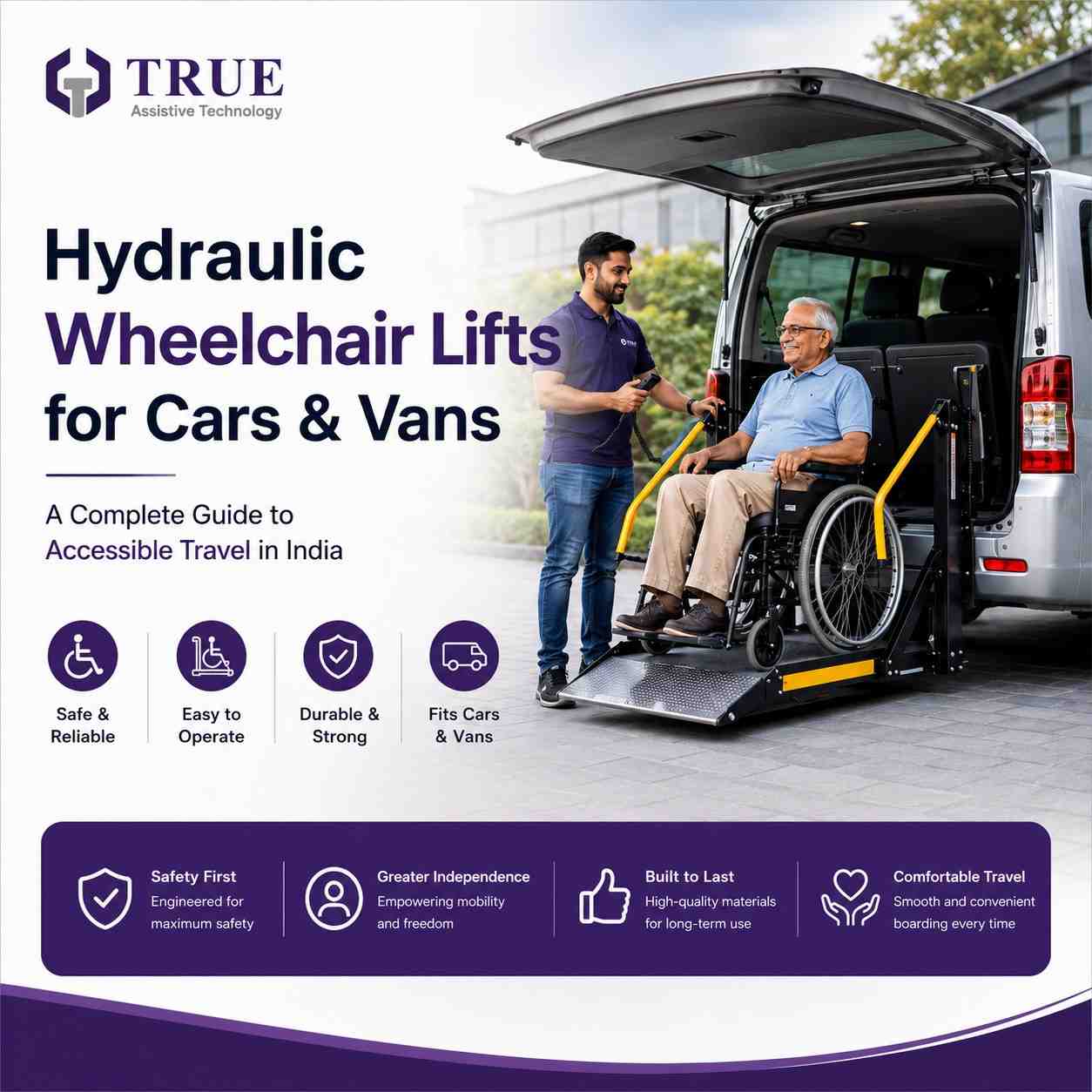
Making Vehicle Travel Accessible for Wheelchair Users in India
For millions of wheelchair users and their families across India, travel is not just a convenience — it is a daily necessity. Doctor appointments, family visits, work, and everyday errands all require reliable, dignified access to vehicles.
Yet getting in and out of a car or van remains one of the biggest physical barriers for wheelchair users. Traditional methods — being lifted manually by caregivers — are unsafe, undignified, and unsustainable over time.
Hydraulic wheelchair lifts for cars and vans solve this problem directly. They provide powered, smooth, and safe vehicle access for wheelchair users — reducing strain on caregivers and restoring independence to the person travelling.
This complete guide covers everything you need to know about hydraulic wheelchair lifts in India: how they work, types available, key features, safety standards, pricing, and how to choose a reliable supplier.
What Is a Hydraulic Wheelchair Lift?
A hydraulic wheelchair lift is a powered platform system fitted to a car, van, or SUV that raises and lowers a wheelchair user safely between ground level and the vehicle floor.
Unlike manual ramps — which require physical effort and space to deploy — hydraulic lifts use a pressurised hydraulic system to do the heavy lifting automatically, with minimal effort from either the user or caregiver.
Core components of a hydraulic wheelchair lift:
| Component | Function |
|---|---|
| Hydraulic pump | Powers smooth lifting and lowering movement |
| Lifting platform | Supports the wheelchair and user safely |
| Control system | Switches, remote controls, or push-buttons for operation |
| Safety locks | Prevents accidental movement during transfer |
| Guard rails | Provides lateral support on the platform |
| Non-slip surface | Ensures the wheelchair stays stable during the lift |
Why Hydraulic Wheelchair Lifts Are Essential for Accessible Travel in India
India's roads, pavements, and public transport systems present unique challenges for wheelchair users. Private vehicle travel often becomes the only practical option — but without the right equipment, even private travel can be physically demanding and risky.
A hydraulic wheelchair lift addresses all of this by:
- Providing independence — the user can board and exit without depending on others to physically lift them
- Ensuring safety — eliminates the risk of falls, slips, or injuries during vehicle transfers
- Reducing caregiver strain — especially important for elderly caregivers or single-parent households
- Saving time — fast boarding and exit compared to manual assistance
- Expanding access — ordinary cars, vans, SUVs, and minibuses can become wheelchair-accessible
For families caring for elderly parents, disabled individuals, or anyone using a powered wheelchair, a hydraulic lift is not a luxury — it is a necessary safety upgrade.
Types of Hydraulic Wheelchair Lifts for Vehicles
Different vehicles and user situations call for different lift configurations. Here are the main types available in India:
1. Platform Hydraulic Lifts
The most common and versatile type. A flat hydraulic platform lowers to ground level, the wheelchair rolls on, and the platform raises to vehicle floor height.
- Best for: Vans, minibuses, high-roof SUVs
- Key advantage: Maximum stability and load capacity
- Ideal user: Full-time wheelchair users, powered wheelchair users
2. Rear-Entry Hydraulic Lifts
Installed at the rear of the vehicle and accessed through the boot or rear doors. The wheelchair user rolls on from behind the vehicle.
- Best for: Vans, SUVs with rear door access
- Key advantage: Works well where side-door space is restricted
- Ideal user: Families who load the wheelchair from the boot area
3. Side-Entry Hydraulic Lifts
Mounted on the side sliding door of a van or minivan. The platform extends outward from the side of the vehicle.
- Best for: Minivans, large vans, commercial accessible vehicles
- Key advantage: Roadside access — user exits directly onto the pavement
- Ideal user: Caregivers who assist with side-door transfers
4. Foldable Hydraulic Lifts
Designed to fold away neatly when not in use, freeing up interior space.
- Best for: Multipurpose family vehicles used for both daily driving and accessibility
- Key advantage: Vehicle remains functional as a regular car when the lift is stowed
- Ideal user: Families who need accessibility occasionally, not full-time
Key Features to Look for in a Hydraulic Wheelchair Lift
Not all wheelchair lifts are equal. When evaluating options in India, prioritise these features:
Safety-critical features:
- Emergency stop control — immediately halts the lift in any situation
- Automatic locking mechanism — secures the platform at both ground and vehicle floor level
- Manual override — allows operation if hydraulic power fails
- Non-slip platform surface — prevents wheelchair wheels from sliding
- Fold-down guard rails — lateral protection during the lift
Practical features:
- Load capacity — must comfortably support the combined weight of the user and wheelchair (powered chairs can be heavy)
- Platform dimensions — must accommodate the full footprint of the wheelchair
- Remote or one-touch operation — easy for the user or caregiver to operate independently
- Stowage design — folds compactly to not interfere with normal vehicle use
- Weatherproofing — rust-resistant materials suited to Indian humidity and monsoon conditions
Compliance and standards:
- ISO safety certification for lifting equipment
- ADA-equivalent design principles for accessible vehicle modifications
- Compliance with vehicle modification regulations applicable in India
Hydraulic Wheelchair Lift vs. Portable Ramp: Which Is Right for You?
| Feature | Hydraulic Wheelchair Lift | Portable Wheelchair Ramp |
|---|---|---|
| Ease of use | Very easy — powered operation | Moderate — requires setup |
| Physical effort required | Minimal | Some effort to deploy/fold |
| Suitable for powered chairs | Yes | Limited — slope may be steep |
| Vehicle compatibility | Vans, SUVs, minibuses | Most vehicles |
| Cost | Higher | Lower |
| Best for | Full-time wheelchair users | Occasional use, manual chairs |
| Caregiver independence | High | Moderate |
Recommendation: For users in a powered wheelchair or those who transfer in and out of vehicles daily, a hydraulic lift is the superior solution. For occasional travel with a lightweight manual wheelchair, a portable ramp may be sufficient.
Cost of Hydraulic Wheelchair Lifts in India
Pricing varies significantly based on several factors:
- Type of lift — platform, rear-entry, side-entry, or foldable
- Load capacity — heavier-duty lifts cost more
- Vehicle compatibility — custom fitment for specific models adds to cost
- Imported vs. locally manufactured — certified imported systems typically offer higher reliability
- Additional features — remote control, advanced safety locks, stainless steel finish
- Installation complexity — some vehicles require structural reinforcement
General price guidance:
| Lift Type | Approximate Price Range (India) |
|---|---|
| Basic foldable platform lift | ₹1,20,000 – ₹2,00,000 |
| Rear-entry hydraulic lift | ₹1,80,000 – ₹3,00,000 |
| Side-entry van lift | ₹2,00,000 – ₹4,00,000 |
| Premium imported platform lift | ₹3,00,000 – ₹6,00,000+ |
Prices are indicative and vary based on supplier, vehicle, and specifications.
Important: Do not evaluate on upfront cost alone. Factor in warranty coverage, spare parts availability, after-sales support, and installation quality — all of which affect the total cost of ownership and long-term safety.
Safety Standards: What to Check Before Buying
Since a hydraulic wheelchair lift carries a person, safety is non-negotiable. Before purchasing, verify:
- Does the lift carry a recognised safety certification (ISO, CE marking, or equivalent)?
- Has the supplier provided certified installations in India previously?
- Is the load capacity clearly tested and documented?
- Does the lift include an emergency stop and manual override?
- Is the platform surface non-slip and weatherproof?
- What is the warranty period and what does it cover?
- Are spare parts available in India — or will repairs require lengthy international shipping?
Cutting corners on safety specifications to reduce cost is a serious risk when the equipment carries a person on a moving platform.
Vehicle Compatibility: Which Cars and Vans Support Hydraulic Wheelchair Lifts?
Hydraulic wheelchair lifts are compatible with a wide range of vehicles commonly available in India:
Vans and minivans:
- Maruti Suzuki Eeco
- Toyota Innova (standard and Hycross)
- Kia Carnival
- Force Traveller (modified accessible van)
SUVs:
- Toyota Fortuner
- Mahindra Bolero (modified)
- Hyundai Tucson
Minibuses and commercial vehicles:
- Tata Winger
- Mahindra Supro
- Force Minibus
Fitment requirements vary by vehicle. Always consult a qualified supplier who can assess your specific vehicle before purchasing a lift.
How to Choose a Hydraulic Wheelchair Lift Supplier in India
The supplier is as important as the product itself. A low-quality installation of even a good lift can create serious safety risks. Choose a supplier who offers:
Certified, tested products
Only consider lifts that come with documented safety certifications and load testing results. Avoid unbranded or uncertified lifts regardless of price.
Custom vehicle integration
The lift must be properly integrated into your specific vehicle model — not simply bolted on. Poor integration affects both safety and the long-term condition of the vehicle.
Professional installation
Installation should be carried out by trained technicians, not general mechanics unfamiliar with accessibility equipment.
Genuine after-sales support
Hydraulic systems require periodic maintenance. Your supplier must offer:
- Regular service schedules
- Spare parts in India (not only available on import)
- Responsive technical support
Warranty coverage
A minimum 12-month warranty on parts and installation is a baseline expectation. Reputable suppliers offer longer warranties on structural and hydraulic components.
Customer references
Ask for evidence of previous installations — ideally with photos or customer testimonials. A trustworthy supplier will have a track record you can verify.
TRUEAssist Technology: Hydraulic Wheelchair Lifts in India
TRUEAssist Technology supplies certified imported hydraulic wheelchair lifts designed and tested for cars, vans, and SUVs commonly used across India.
Why customers choose TRUEAssist:
- Internationally certified hydraulic lift systems
- Fitted to specific vehicle models — not generic installations
- Professional installation team with accessibility equipment experience
- After-sales service and maintenance support in India
- Part of a complete accessible vehicle ecosystem including swivel seats and portable wheelchair ramps
Explore the TRUEAssist Hydraulic Wheelchair Lift.
Frequently Asked Questions: Hydraulic Wheelchair Lifts in India
What is the weight capacity of a hydraulic wheelchair lift?
Most hydraulic wheelchair lifts support between 150 kg and 350 kg combined (user and wheelchair). Powered wheelchairs can weigh 100–150 kg, so always verify the lift's rated capacity matches your specific wheelchair and user weight.
Can a hydraulic wheelchair lift be fitted to any car?
Not every vehicle is suitable. Hydraulic lifts are primarily fitted to vans, SUVs, and minibuses that have sufficient floor height and structural capacity. A qualified supplier can assess whether your vehicle is compatible before purchase.
How long does installation take?
A professional installation typically takes one to three days depending on the vehicle model and lift type. Structural reinforcement — if required — may extend this timeline.
Is a hydraulic lift better than a manual ramp for a powered wheelchair?
Yes. Powered wheelchairs are heavy and cannot safely navigate steep manual ramps. A hydraulic lift provides a flat, powered platform that accommodates powered chairs safely and comfortably.
What maintenance does a hydraulic wheelchair lift require?
Hydraulic systems should be serviced every 6–12 months. This includes checking hydraulic fluid levels, inspecting seals and hoses, testing safety locks, and verifying the platform surface condition.
Are hydraulic wheelchair lifts legal in India?
Vehicle modifications in India must comply with the Motor Vehicles Act. Accessibility modifications for disability-related needs are generally permitted but should be carried out by registered modifiers and documented appropriately. Consult your supplier and RTO for specifics applicable to your state.
What is the price of a hydraulic wheelchair lift in India?
Prices range from approximately ₹1,20,000 for entry-level foldable lifts to ₹6,00,000 or more for premium imported platform lifts with advanced features and larger load capacities.
Conclusion: Investing in a Hydraulic Wheelchair Lift Is Investing in Independence
A hydraulic wheelchair lift for a car or van is one of the most significant investments a wheelchair user or their family can make in India. The right lift removes the daily struggle of vehicle access, reduces caregiver burden, and gives the wheelchair user genuine independence and dignity in travel.
Whether you are caring for an elderly parent, supporting a family member with a disability, or managing your own mobility needs, a hydraulic wheelchair lift transforms what is possible — every single day.
Choose a certified product, a professional installer, and a supplier with genuine after-sales support. The difference between a quality installation and a poor one is not just comfort — it is safety.
Published by TRUEAssist Technology Pvt Ltd — India's trusted provider of vehicle accessibility solutions including hydraulic wheelchair lifts, swivel seats, and portable wheelchair ramps.
Website: www.trueassistech.com/products | Contact: www.trueassistech.com/contact-us